Drying to a measured standard
Structural Drying in Diamondhead, MS
Drying a house is a measured job: LGR dehumidifiers and air movers are set by the class of loss, and daily readings on walls, floors and framing decide when the equipment can come out.
(888) 417-5665Call about wet walls and floors- LGR dehumidifiers
- Air movers by class
- Daily psychrometric logs
Right now
First steps for structural drying
- Open the cabinets. Open doors and drawers on wet cabinets so air can reach the inside.
- Leave the equipment alone. Keep air movers and dehumidifiers running and plugged in until the crew says they are done.
- Close the windows. Keep exterior doors and windows shut so humid air does not undo the drying.
- Keep a log. Note any new stains or smells and tell the crew at the next reading.
The trade facts behind the work
- Equipment is placed by loss class and moved as the readings change.
- Daily readings of moisture, temperature and humidity are logged for every room.
- Drying ends when each material reads dry, not when a calendar day arrives.
Walls and floors still wet? Call the drying team (888) 417-5665
How the work runs
How structural drying is handled, step by step
- 1
Classify
The loss class and water category are set from the first readings.
- 2
Place
Air movers and dehumidifiers go in by room volume and class.
- 3
Read daily
Moisture, temperature and humidity are logged and compared.
- 4
Release
Equipment leaves when each material reads dry.
Typical cost
What does structural drying cost in Diamondhead, LA?
Cost follows the class of loss and the number of rooms. Class 1 or 2 in one or two rooms is the lowest range, Class 3 across several rooms the middle, and Class 4 on slab, hardwood or plaster the highest, with longer monitoring.
Class 1 or 2, one or two rooms
$1,200 to $2,800
- Air movers and an LGR dehumidifier
- Three to four days
- Daily readings
Class 3, several rooms
$2,800 to $5,500
- Wall and ceiling cavity drying
- More equipment per room
- Psychrometric logs
Class 4, slab, hardwood or plaster
$5,500 to $10,000+
- Desiccant dehumidifiers
- Containment and floor mats
- Longer monitoring
These are typical ranges, not a quote. The category of water, the square footage, the material class and how fast drying started move the number most. Try the water damage cost calculator for a planning figure.
Extraction removes the water, and structural drying removes what the materials still hold. The backdrop is a wet one: FEMA's Hancock County flood study puts rainfall near 62 inches a year, mostly from July through September, and the area's flood history includes Hurricane Katrina, Hurricane Zeta and Tropical Storm Claudette. Drying decides whether any of that water leaves lasting damage. Whether a loss comes from a burst pipe, a storm or flood water, the plan is built from readings taken at the first visit.
Classes of water loss
The IICRC S500 standard sorts losses by how much water the materials absorbed, and the class sets how much equipment each room gets. Heavier classes need more machines and more time.
- Class 1 or 2: small areas and low-porosity materials
- Class 3: ceilings, walls and insulation soaked from above
- Class 4: hardwood, plaster and concrete holding deep moisture
Equipment and placement
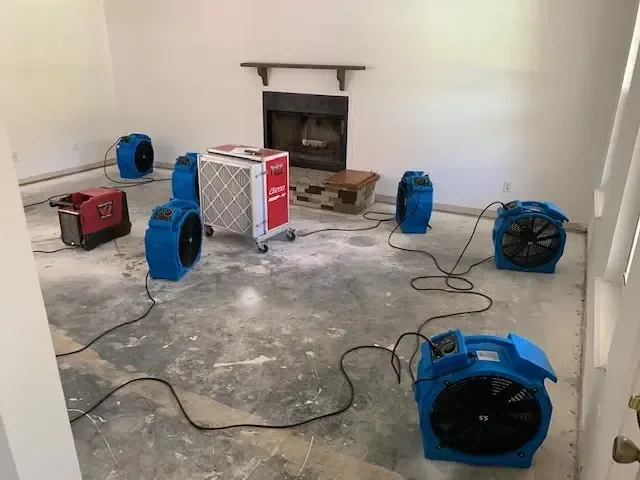
Air movers are aimed along walls and across floors to lift moisture off surfaces, while dehumidifiers pull that moisture out of the air so it cannot settle back into the materials. Placement follows the room volume and the class of loss: more machines go into wetter rooms, and equipment is repositioned as walls and floors begin to dry.
- Air movers aimed along walls and floors
- LGR dehumidifiers sized to the room volume
Readings decide the finish
Moisture content, temperature and humidity are logged every day, and the plan changes with the numbers: equipment moves, cavities are opened, or a stalled area gets desiccant units. Drying ends only when each material reads at its dry standard, which can be sooner or later than expected.
Where drying fits
Water extraction comes first, and flood water cleanup adds removal and treatment ahead of the drying. The drying time estimator gives a rough range.
Service area
Structural Drying across Diamondhead and nearby
Drying equipment goes into homes and condominium units across the city, from Lanai Village and Molokai Village to Fairway Estates, Glen Eagle and Pine Ridge Estates and the streets around Twin Lakes.
The same service nearby: structural drying in Slidell, Waveland, Picayune.
See every town coveredRelated
Related water damage services
Questions
Structural Drying questions, answered
How long does structural drying take?
Three to four days is typical for a small clean-water loss, and the range stretches to a week or two for wet hardwood, plaster, concrete or flood damage. The readings set the end.
Why are the machines so loud?
Air movers push air across wet surfaces and dehumidifiers pull the moisture out of it, and both run around the clock for the drying to work. Switching them off to sleep stalls the process.
Can the house be lived in during drying?
Often yes, with some noise and warmth. Containment, sewage or very large losses may require rooms to be closed, and the crew will say which ones.
What is an LGR dehumidifier?
A low grain refrigerant unit that pulls moisture from the air at low humidity better than a standard household unit, which is why it is the workhorse of structural drying.
How does the crew know it is dry?
Moisture meters read each material against the dry standard for that material, and the readings are compared with an unaffected area of the same house.
Does the rainy season change the plan?
Heavy rain raises outdoor humidity, so doors and windows stay closed and dehumidifiers do more work. FEMA's Hancock County flood study notes rainfall near 62 inches a year, mostly from July through September.
24/7 water damage dispatch
Dry to the meter, not to the touch
Equipment is placed by loss class, readings are logged every day, and the machines leave only when each material meets its dry standard.