Drying to a measured goal
Structural Drying in Slidell, LA
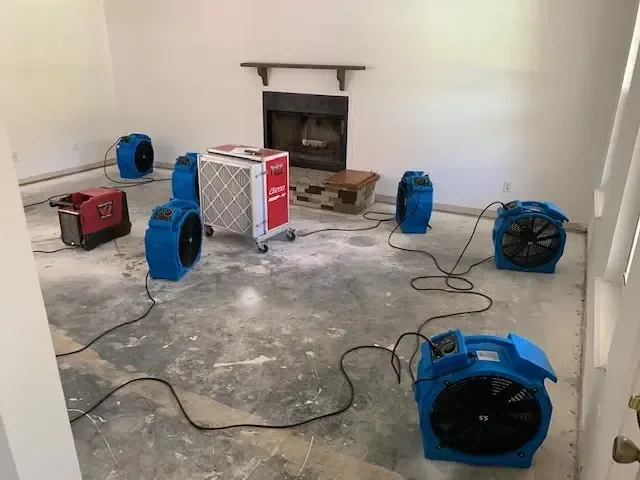
Surfaces dry in a day; framing, subfloor and slabs do not. The drying team sets air movers and dehumidifiers to the class of loss, logs readings every day and keeps the equipment running until the structure is dry.
(888) 417-5665Walls still wet? Start real drying- LGR and desiccant units
- Psychrometric logs
- Dry reference readings
Right now
First steps for structural drying
- Close the house. Keep windows and doors shut so humid outside air stays out.
- Run the AC. If it works and is safe to run, the AC helps pull moisture from the air.
- Leave equipment on. Do not switch off air movers or dehumidifiers between visits.
- Leave containment alone. Keep plastic walls and doors the way the drying team set them.
The trade facts behind the work
- Class 1 to 4 sets how much equipment each room needs.
- Daily psychrometric logs prove the drying is working.
- The goal is a reading within 2 to 4 points of a dry reference.
Walls or floors still wet days later? Call (888) 417-5665
How the work runs
How structural drying is handled, step by step
- 1
Map
Find every wet material and take a dry reference.
- 2
Set equipment
Air movers and dehumidifiers sized to the class of loss.
- 3
Monitor
Daily psychrometric and moisture readings, equipment adjusted.
- 4
Confirm dry
Readings within 2 to 4 points of the dry reference.
Typical cost
What does structural drying cost in Slidell, LA?
In Slidell, LA, structural drying typically runs $1,200 to $8,000, depending on the class of loss, how many rooms are drying, how many days the equipment runs and whether desiccant units are needed for slabs or hardwood.
Class 1 or 2, one or two rooms
$1,200 to $2,800
- Air movers and an LGR dehumidifier
- Three to four days
- Daily readings
Class 3, several rooms
$2,800 to $5,500
- Wall and ceiling cavity drying
- More equipment per room
- Psychrometric logs
Class 4, slab, hardwood or plaster
$5,500 to $10,000+
- Desiccant dehumidifiers
- Containment and floor mats
- Longer monitoring
These are typical ranges, not a quote. The category of water, the square footage, the material class and how fast drying started move the number most. Try the water damage cost calculator for a planning figure.
Structural drying is the part of a water job that decides whether it is really over. Drywall can feel dry while the stud behind it is still wet, and a slab can look fine while it holds water under the flooring. Gulf Coast air is humid most of the year, so the drying team works with the house closed up and lets the dehumidifiers set the conditions.
Class of loss sets the equipment
The IICRC S500 sorts losses into Class 1 to 4 by how much water got into the materials and how hard they are to dry. A Class 1 loss is a small area with little absorbed water. Class 4 means dense materials like hardwood, plaster or concrete that hold water deep. Higher classes need more air movement and lower humidity, and Class 4 often calls for desiccant dehumidifiers.
- Class 1 and 2: air movers and LGR dehumidifiers
- Class 3: wet ceilings and walls, more air and dehumidification
- Class 4: hardwood, plaster or slab, often desiccant units
Readings, not guesses
Every day the drying team records temperature and humidity inside and outside the drying area, plus moisture readings on the wet materials. Those psychrometric logs show whether the drying is working and when to move equipment. The job ends when wet materials read within 2 to 4 points of a dry reference material in the same house, not on a set date.
- A dry reference reading taken on unaffected material
- Daily readings on every mapped wet spot
- Equipment adjusted or moved as areas dry
Why humid air changes the plan
Opening windows to dry a house works in a dry climate. Here it lets humid outside air in and slows everything down, so closed-up drying with dehumidifiers is the standard approach. EPA moisture guidance is to dry wet materials within 24 to 48 hours, and the National Weather Service forecast office in Slidell publishes local dew point forecasts, a quick read on how humid the outside air is.
Service area
Structural Drying across Slidell and nearby
The extraction crew and the drying team cover ZIP codes 70458, 70459, 70460 and 70469, from Olde Towne and the Gause Boulevard corridor to Cross Gates, Kingspoint and the lakefront canals of Eden Isles and Oak Harbor.
Nearby coverage reaches Pearl River, Lacombe, Mandeville, Covington, Picayune, Waveland and Diamondhead.
See every area and ZIP coveredRelated
Related water damage services
Questions
Structural Drying questions, answered
How is structural drying different from fans and open windows?
Professional air movers and dehumidifiers are sized to the class of loss and measured every day. Open windows let humid outside air in, which slows drying here.
How long does structural drying take?
Usually three to five days for Class 1 and 2 losses. Hardwood, plaster and slabs can take a week or more.
What is a dry reference?
A moisture reading on the same kind of material in an unaffected part of the house. The job ends when wet materials read within 2 to 4 points of it.
Why is the equipment so loud and warm?
Air movers push large volumes of air across wet surfaces, and LGR dehumidifiers give off heat while they pull water out. Both speed up evaporation.
Can the equipment be turned off at night?
Drying is continuous, and switching off adds days. If the noise is a problem in a bedroom, ask the drying team about moving a unit.
What goes into the drying log?
Daily temperature, humidity and grains per pound inside and outside the drying area, plus moisture readings on each mapped spot. The log goes into the claim file.
24/7 water damage dispatch
Still damp after a leak? Dry it to a reading, not a guess.
The drying team sizes the equipment to the class of loss and logs readings every day until the structure is dry.