Dry to documented targets
Structural Drying in Covington, LA
After flooding like March 2016, Tropical Storm Allison in 2001 or the street flooding of June 2026, wet walls, floors and framing need controlled drying, with equipment matched to the materials and daily readings proving progress.
(888) 417-5665Call about structural drying- LGR dehumidifiers
- Daily psychrometric logs
- Desiccant for slabs
Right now
First steps for structural drying
- Open the room up. Open doors and cabinets so air reaches wet surfaces.
- Keep belongings off. Lift furniture legs and curtains off wet floors and walls.
- Skip box fans. Household fans and heaters only move humid air around.
- Log the damage. Photograph wet areas and note which rooms, so readings can be compared later.
The trade facts behind the work
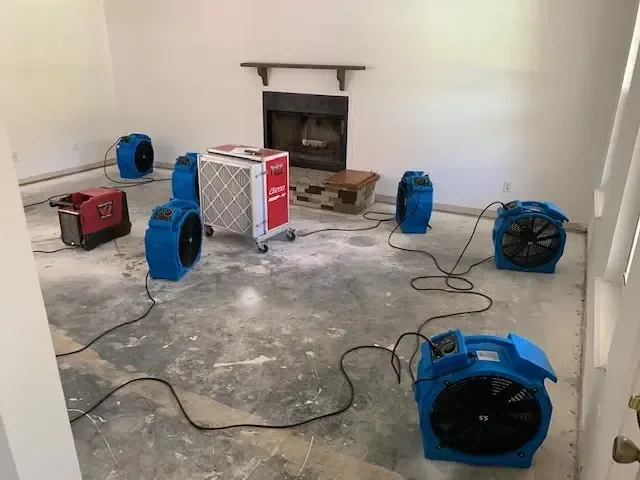
- LGR dehumidifiers handle most jobs, with desiccant units for dense materials.
- Air movers are placed by wall and floor layout, not by a fixed number per room.
- Psychrometric logs of temperature and humidity prove the room is drying.
Wet walls or floors? Talk to the crew: (888) 417-5665
How the work runs
How structural drying is handled, step by step
- 1
Classify
The water source and affected materials set the drying class.
- 2
Set equipment
LGR dehumidifiers and air movers are placed by room layout.
- 3
Monitor daily
Temperature, humidity and moisture content are logged each visit.
- 4
Release the gear
Equipment is removed when every material meets its dry reference.
Typical cost
What does structural drying cost in Covington, LA?
Class 1 or 2 drying in one or two rooms costs about $1,200 to $2,800. Class 3 across several rooms runs $2,800 to $5,500, and Class 4 work on slab, hardwood or plaster reaches $5,500 to $10,000+.
Class 1 or 2, small area
$1,200 to $2,800
- Air movers, LGR dehumidifier
- Equipment for a few days
- Daily readings
Class 3, several rooms
$2,800 to $5,500
- Wall and ceiling cavities dried
- More equipment per room
- Psychrometric logs kept daily
Class 4, slab, hardwood or plaster
$5,500 to $10,000+
- Desiccant dehumidifiers on site
- Containment and floor mats
- Longer monitoring
These are typical ranges, not a quote. The category of water, the square footage, the material class and how fast drying started move the number most. Try the water damage cost calculator for a planning figure.
Structural drying is the part of water damage that nobody sees and everybody depends on. It removes the moisture that soaked into framing, subfloors and drywall, and it is done to measured targets rather than to a calendar.
Why flood events leave wet structure
Whenever flood or leak water gets into a building, drywall, plaster, wood and concrete keep moisture long after the surface looks dry, and a meter can still read far above normal days later.
- Drywall and insulation hold water in wall cavities
- Subfloors and hardwood swell and cup as they take on moisture
- Concrete and plaster release moisture slowly
How drying equipment is chosen
Water damage is sorted by class. Class 1 and 2 jobs, with a small area or damp materials, run on LGR dehumidifiers and air movers. Class 3 adds wall and ceiling cavities and more equipment per room, and Class 4 covers dense materials like slab, hardwood and plaster, which often need desiccant dehumidifiers.
Daily readings, not guesses
Each visit records temperature, humidity and moisture content in the walls, floors and framing, and equipment is moved or removed as materials reach their reference values. The drying time estimator offers a rough starting expectation only.
Gear stays in place until every monitored material reads within range of unaffected reference points, which is the proof the adjuster and the contractor who rebuilds both need. Pulling gear too early invites swelling, odor and rot.
Where it fits in a job
Drying follows water extraction and any removal of ruined materials, and it continues after flood water cleanup or sewage removal. It is the step that makes the rebuild safe to start. Skipping this step is the usual reason a repaired room smells damp a month later.
Service area
Structural Drying across Covington and nearby
Structural drying covers homes and businesses across Covington, from historic downtown buildings and the Columbia Street shops to River Forest, the Savannahs and the West 30s, and from the Collins Boulevard corridor to apartment communities around Business 190.
The same service nearby: structural drying in Slidell, Mandeville, Picayune.
See every town coveredRelated
Related water damage services
Questions
Structural Drying questions, answered
How long does structural drying usually take?
It varies with the materials and how wet they got, so no fixed number applies. Many jobs need several days, while slab, hardwood and plaster take longer, and daily readings decide when the equipment can go.
Why is the equipment so loud and hot?
Air movers push air across wet surfaces and dehumidifiers pull moisture out of it, which creates noise and warmth. Both are normal.
Can the air conditioner help dry a wet room?
It helps a little, but a house system is not built to remove this much moisture. LGR dehumidifiers pull far more water from the air, so they do the main work.
What are psychrometric readings?
They are measurements of air temperature, relative humidity and the moisture the air can hold, taken alongside moisture meter readings in materials. Together they show whether the drying environment is working.
Can wet hardwood floors be saved?
Sometimes. Fast extraction and drying mats or desiccant drying can save solid hardwood when it has not cupped badly, but engineered and glued floors often have to come up.
How do I know the structure is actually dry?
The final readings are compared with unaffected reference materials in the same building, and the logs showing that match are kept for the adjuster and the contractor.
24/7 water damage dispatch
Dry the structure to measured targets
Tell the crew what got wet, the materials involved and for how long, and the plan for equipment, readings and sign-off follows from there.